
 Español
 русский
 عربى
عربىIndustry News

How To Choose Women Sunglasses Small Frame For Face Balance
Author: Admin
Date: Aug 28,2026
Choosing a small pair of sunglasses is not simply a matter of selecting a shorter frame. What matters visually is how much of the face becomes covered, how much space remains around the lenses, and where the eyes sit within the frame.
A compact frame leaves more of the face visible. As a result, facial width, cheek area, brow position, and the distance between the frame and the temples become easier to notice. A frame that appears small in a product photo may therefore look quite different once placed on a face.
For Women's Sunglasses Small Frame, facial balance often depends on proportion rather than a fixed size label. Two frames with similar outside measurements can create different impressions when one has a taller lens, another has a narrow bridge, or one extends farther toward the temples.
Visual balance can be considered through three simple areas:
- Coverage: how much facial area sits behind the lenses
- Spacing: how much open space remains around the frame
- Direction: where the shape draws attention
A narrow rounded frame tends to keep attention near the center of the face. A frame with raised outer corners can move attention outward and upward. Neither approach is automatically suitable for every face, since natural facial proportions vary considerably.
For practical selection, looking at the frame in relation to the face is more useful than judging the frame by itself. A mirror check from a normal viewing distance can reveal whether the frame appears connected to the facial outline or seems visually separated from it.
How Does Frame Width Affect the Space Around the Face
Frame width has a direct effect on the amount of visible space beside the lenses. A very narrow frame can leave noticeable areas between the frame edges and the sides of the face, while a wider design fills more of the horizontal area.
Such spacing changes the visual weight of a pair of sunglasses. When a frame sits close to the natural width of the face, the outline can appear more continuous. A smaller frame with considerable space at both sides creates a stronger contrast between the glasses and the surrounding facial area.
Temple placement is part of the same picture. Frame arms that begin too far inward may make a frame feel narrower even when its front appears reasonably wide. Arms that extend too far outward can create a different fitting problem and may affect stability during movement.
A useful check involves looking straight ahead while keeping the head in a natural position. Attention can then be given to:
- Outer edge: Does the frame sit naturally within the width of the face?
- Temple area: Do the arms begin around a comfortable position?
- Lens area: Are both eyes placed naturally within the openings?
- Side spacing: Does excessive empty space make the frame appear disconnected from the face?
Size markings can provide useful information, although numbers alone cannot predict visual balance. Lens shape, bridge position, frame thickness, and facial structure all change how a given width appears.
What Happens When the Eyes Sit Differently Inside Small Frames
Eye position is easy to overlook when selecting sunglasses. A frame may have an appealing shape, yet the visual result can feel unusual when the eyes sit too high, too low, or too close to one side of each lens.
Small frames leave less room for positional variation. A taller lens provides more vertical space around the eye, while a shallow lens creates a tighter opening. Bridge placement also changes where the two lenses sit relative to the eyes.
For facial balance, the aim is not to place the eyes at one exact point. A natural relationship between eye position and lens opening tends to create a more settled appearance.
Several details can be checked while wearing a frame:
- Pupils should not appear crowded against an inner or outer edge.
- Lens openings should provide practical space around the eyes.
- Bridge placement should keep both sides visually even.
- Frame height should work with brow and cheek proportions.
- Glasses should remain in position during normal head movement.
Nose shape can affect the result as well. A frame that slides downward changes eye position and may make the frame look larger or smaller than expected. A stable fit therefore contributes to visual balance as well as comfort.
Photographs can sometimes reveal positioning more clearly than a quick mirror glance. A front‑facing image shows whether the frame sits evenly, while a slight side angle can reveal whether the bridge and temples are holding the frame in a natural position.
How Do Cat Eye Corners Shift Facial Attention
Cat eye frames introduce another element that a simple compact frame does not always have: direction. Outer corners rise toward the temples, creating an upward movement across the upper part of the face.
Such an angle can draw attention toward the brow and outer eye area. For some facial structures, that direction creates a useful connection between the frame and existing facial lines. For other proportions, a strong corner may attract too much attention to one area.
Corner height matters more than the cat eye label alone. A gentle upward curve produces a different visual impression from a sharply raised outer edge. Frame width also changes how noticeable the corner becomes.
| Frame Feature | Visual Role | What to Check |
|---|---|---|
| Frame Width | Controls Horizontal Coverage | Relationship With Facial Width |
| Lens Height | Changes Vertical Coverage | Space Around the Eyes |
| Outer Corner | Creates Direction | Connection With Brow Area |
| Bridge Position | Sets Lens Placement | Eye and Nose Alignment |
| Frame Thickness | Adds Visual Weight | Balance With Facial Features |
Frame corners can also influence perceived face width. A design extending slightly outward may make attention move toward the sides, while a compact rounded corner keeps more attention near the center.
Rather than treating cat eye shapes as a single category, looking at corner direction, width, height, and thickness gives a clearer basis for comparison. Such details become particularly noticeable with smaller frames because limited lens area leaves less room for visual elements to spread across the face.
Can Oversized Cat Eye Shapes Work With Small Frame Preferences
Small frame preferences do not always mean that every part of a pair of sunglasses needs to look compact. Lens height, outer corners, and frame width can be adjusted independently, creating very different visual proportions within a similar overall style.
Polarized Oversized Cat Eye Sunglasses provide a useful comparison. A larger lens area covers more of the face, while raised outer corners create an outward and upward direction. Such a shape can produce a stronger visual presence than a compact rounded frame, even when both designs share a similar cat eye idea.
Face width remains relevant. A broad frame may extend close to or beyond the natural facial outline, while a narrower design leaves more visible space around the temples. Lens height adds another layer. Taller lenses cover more vertical space around the eyes and upper cheeks, creating a different balance from shallow lenses.
Oversized designs can work with smaller facial proportions when frame dimensions remain visually connected to the face. Excessive width or height may instead make facial features appear less prominent because a larger area becomes occupied by the glasses.
A few points are useful when comparing larger cat eye shapes:
- Check overall width rather than focusing only on the lens shape.
- Look at how far outer corners extend toward the temples.
- Compare lens height with the visible area around the eyes.
- Consider frame thickness together with lens size.
- Check whether the frame stays stable during ordinary movement.
Polarization addresses light passing through the lenses rather than facial proportion, so optical function and frame balance should be considered separately. A pair can reduce certain forms of reflected light while still having a shape that feels too large or too narrow for a particular face.
How Does Frame Thickness Influence the Balance
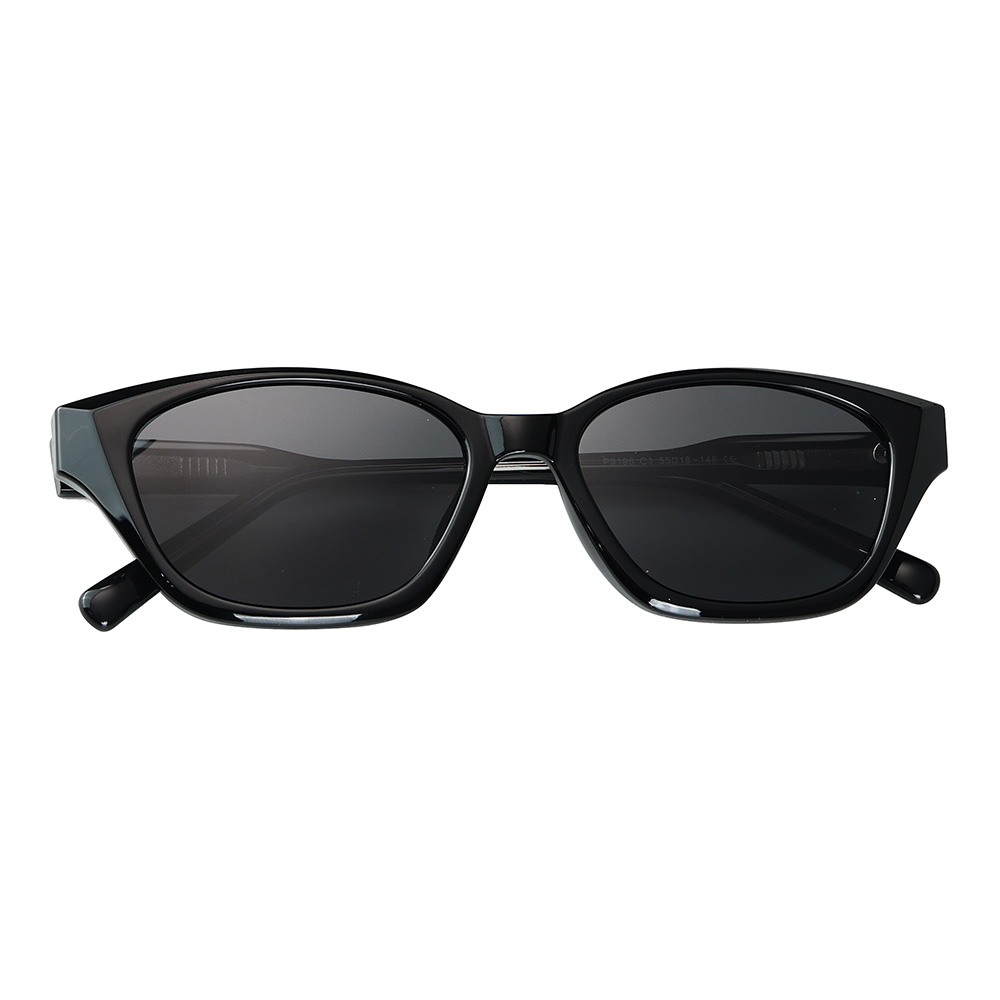
Frame thickness can quietly change how a small pair of sunglasses looks. A narrow lens surrounded by a heavy frame may appear visually dense, while a similar lens surrounded by a fine frame can leave more attention on the face.
Thickness becomes especially noticeable around the upper edge. A heavier upper frame can create a stronger line near the brow, while a lighter lower edge allows more of the cheek area to remain visible.
Different combinations create different results:
- Small lens + thick frame A compact lens can appear visually stronger because the surrounding frame occupies more space.
- Small lens + thin frame More of the facial area remains visible, creating a lighter overall appearance.
- Larger lens + thick frame Both lens area and frame weight become noticeable, producing a more defined visual structure.
- Larger lens + thin frame A larger viewing area remains without adding as much visual weight around its edges.
Frame color can strengthen or soften the effect. Darker edges tend to form a clearer boundary around the eyes, while lighter or translucent edges may blend more gently with surrounding features.
For Women's Sunglasses Small Frame, thickness therefore deserves attention alongside width. A frame that appears suitably narrow can still feel visually heavy when its borders occupy a large portion of the front surface.
What Should Be Checked From the Front and Side
A front view gives useful information about facial balance, although side viewing can reveal fitting details that are difficult to notice in a mirror.
From the front, attention can remain on four areas:
- Overall frame width
- Eye position within each lens
- Lens height
- Space between frame and facial outline
An even position across both sides generally gives a more settled appearance. A frame that sits slightly crooked can change the apparent balance, even when its dimensions are otherwise suitable.
Side viewing brings different questions. Nose contact, lens distance from the face, temple position, and frame angle become easier to see. A frame that looks balanced from the front may slide forward or downward during wear, changing its position around the eyes.
Movement is worth checking as well. Walking, looking downward, turning the head, or speaking can cause a poorly fitted frame to shift. Once the frame moves, visual proportions change with it.
A simple fitting check can follow a natural sequence:
- Put on the sunglasses without adjusting them repeatedly.
- Look straight ahead and check eye placement.
- Turn the head gently from side to side.
- Look downward for a moment.
- Check whether the frame remains level.
- View the frame from the side.
Comfort should remain part of the assessment. Pressure around the temples or nose may encourage repeated adjustment, which can gradually change how the frame sits.
How Can Small Frame Features Be Matched More Precisely
Choosing a suitable frame becomes easier when several small details are considered together rather than relying on a single face‑shape category. Facial balance comes from relationships, so frame width alone cannot provide a complete answer.
Width gives a starting point. Lens position then shows whether the eyes sit naturally inside the openings. Corner direction determines where visual attention moves, while frame thickness controls how much visual weight sits around the lenses.
A practical comparison can follow five questions:
- Is the width in proportion to the face? Look at the space beside the temples rather than judging width from the frame alone.
- Are the eyes comfortably positioned within the lenses? Check both horizontal and vertical placement.
- Do the outer corners create a useful direction? A gentle upward shape may interact differently with facial lines than a sharp corner.
- Does frame thickness suit the lens area? A compact lens surrounded by heavy borders can appear quite different from one surrounded by fine edges.
- Does the frame stay in place? Movement changes both comfort and visual proportion.
A useful selection process can begin with the face viewed naturally, followed by frame width, lens placement, corner shape, and thickness. Color and lens treatment can then be considered once the basic proportions feel appropriate.
No single frame construction produces the same appearance on every person. Facial width, brow position, nose shape, cheek structure, and personal preference all influence the final result. A balanced choice usually comes from observing how several features interact rather than following a simple rule based on face shape alone.

Customized For Your Business
Combining fine craftsmanship with automation technology, we create glasses that are competitive in the market.
Quick Links
Information
Contact Us
-
 No. 7-1, Dengtou Industrial Zone, Duqiao Town, Linhai City, Taizhou City, Zhejiang Province
-
 +86-13666884088
-
 +86-13666884088
-
 +86-573-85505155
-
 [email protected]
Copyright © Zhejiang Zhansheng Glasses Co., Ltd.Rights Reserved.
OEM Eyeglass & Glasses Manufacturer
