
 Español
 русский
 عربى
عربىIndustry News

How Do Metal Polarized Sunglasses Help Reduce Glare Outdoors
Author: Admin
Date: Oct 02,2026
Bright outdoor light can look very different depending on where it comes from. Direct sunlight is only part of the problem. Reflections from roads, water, glass, vehicles, and other smooth surfaces can create strong glare that makes outdoor viewing less comfortable. This is where polarized eyewear becomes relevant. Metal Polarized Sunglasses combine a metal frame with polarized lenses, giving buyers a product category that connects everyday style with a practical lens function.
The basic idea is fairly simple. A polarized lens uses a filter that limits certain directions of reflected light before it reaches the eyes. Instead of simply making the entire scene darker, polarization is designed to reduce a specific type of reflected light that commonly appears around bright outdoor surfaces.
Why Does Outdoor Glare Happen?
Glare is often created when sunlight hits a flat or smooth surface and reflects toward the viewer. A road after rain, a lake on a sunny afternoon, a vehicle hood, a building window, or even light-colored pavement can send strong reflected light into the field of view.
That reflected light can make surfaces appear unusually bright. In some situations, people may instinctively squint or change their viewing angle to deal with it. For eyewear designers and buyers, understanding this behavior helps explain why polarization is used in outdoor sunglasses.
Common Sources Of Reflected Glare
- Wet pavement after rain
- Open water under direct sunlight
- Vehicle windows and exterior surfaces
- Glass building facades
- Bright pavement and outdoor structures
- Snow and other highly reflective surfaces
The important point is that glare is not simply a question of brightness. The direction and character of reflected light also matter.
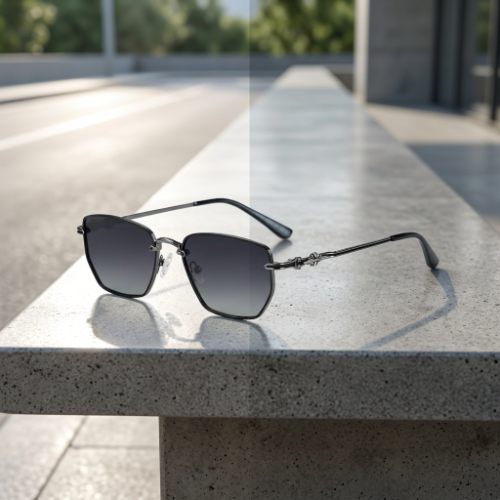
How Does Polarization Change The Way Glare Is Viewed?
Polarized lenses contain a filtering layer that is designed to limit horizontally oriented reflected light. Much of the glare produced by flat outdoor surfaces has this characteristic, which is why polarized lenses are commonly associated with driving, travel, fishing, boating, hiking, and other daytime activities.
A standard tinted lens mainly reduces the amount of light entering the eye. A polarized lens takes a different approach by filtering a particular portion of reflected light. The result can be a more comfortable visual experience when strong reflections are present.
This distinction is important for buyers. Lens darkness and polarization are not the same feature. A darker lens does not automatically provide the same glare-management function as a polarized lens.
Where Can Metal Polarized Sunglasses Be Useful?
The usefulness of polarized eyewear depends on the environment. Outdoor situations with bright reflective surfaces are particularly relevant because the lens is dealing with more than direct sunlight.
| Outdoor Situation | Common Glare Source | Why Polarization Matters |
|---|---|---|
| Driving | Roads, vehicle surfaces, glass | Helps manage reflected light during bright daytime conditions |
| Water Activities | Water surface | Can reduce strong reflections from the water |
| Travel | Pavement, windows, vehicles | Useful when moving between different outdoor environments |
| Walking And Urban Use | Glass, concrete, vehicles | Helps limit distracting reflected light |
| Outdoor Leisure | Ground surfaces and natural surroundings | Provides a practical option for bright daytime conditions |
These applications do not mean every outdoor situation requires polarized eyewear. The value becomes more noticeable when reflected light is a significant part of the visual environment.
Why Does The Metal Frame Matter?
Polarization is a lens feature, while the frame determines how the eyewear is constructed, positioned, and presented. In Metal Polarized Sunglasses, these two elements come together as part of one product design.
Metal frames can support a clean and structured appearance. Depending on the design direction, manufacturers can work with different frame shapes, bridge details, temple treatments, finishes, and lens combinations. This gives brands and buyers room to develop collections for different market preferences.
The frame also affects how the sunglasses sit on the face. Bridge design, temple length, frame width, lens shape, and nose contact points can all influence the wearing experience. For this reason, sourcing should not focus on polarization alone.
Small Frame Details Can Change The Product
- Frame shape influences the overall visual character.
- Bridge construction affects how the eyewear sits on the nose.
- Temple design contributes to fit and everyday handling.
- Lens shape changes the relationship between fashion and coverage.
- Surface finish can influence the appearance of the metal construction.
These details become especially relevant when developing a collection rather than selecting a single sample.
What Should Buyers Consider When Sourcing Polarized Eyewear?
For wholesale, OEM, and private label projects, the buying process usually involves more than asking whether a lens is polarized. Product consistency, frame construction, design direction, lens options, finishing, and production communication can all affect the final result.
A practical sourcing checklist may include the following areas:
- Lens function: Confirm that the intended lens type matches the target market and application.
- Frame construction: Review the structure, joints, bridge, temples, and finishing details.
- Design language: Consider whether aviator, round, square, oval, or geometric shapes fit the planned collection.
- Fit: Check how the frame dimensions and construction relate to the intended wearer.
- Sample consistency: Compare samples carefully before moving into larger production quantities.
- Market positioning: Match frame styling, lens color, and finishing with the preferences of the intended customer group.
This approach helps buyers look at the product as a complete piece of eyewear rather than treating the polarized lens as the only selling point.
Does Polarization Mean The Sunglasses Are Suitable For Every Situation?
Not necessarily. Polarization is particularly relevant to reflected glare, but it does not replace good product selection for every environment.
One practical consideration is electronic displays. Some LCD screens can appear darker or less clear through polarized lenses depending on the screen and viewing angle. This is worth considering when eyewear is intended for users who frequently switch between outdoor activities and digital displays.
Night use is another separate consideration. Tinted sunglasses are intended for bright conditions and should not be treated as night-driving eyewear. The appropriate use depends on the lens category and local requirements.
Polarization should therefore be viewed as one part of an eyewear design, not a substitute for considering the full use environment.
How Can Manufacturers Turn Glare Reduction Into A Practical Design?
For a sunglasses manufacturer, the interesting part is connecting optical function with a design that people actually want to wear.
A metal polarized collection can explore different visual directions without changing the basic purpose of the product. A thin metal frame may create a lighter visual impression, while a double-bridge design can give an aviator-inspired model a different character. Round and oval lenses can create a softer appearance, while square and geometric shapes can offer a more defined look.
Lens color also contributes to the overall design language. Gray, brown, green, and other lens tones can create different visual impressions and may be selected according to the intended collection and market.
The manufacturing process is therefore not simply about attaching a polarized lens to a metal frame. Product development involves coordinating the frame structure, lens design, finishing, assembly, fit, and appearance into one finished item.
What Does This Mean For Outdoor Eyewear Buyers?
The main reason polarized sunglasses attract attention is easy to understand: outdoor glare can come from many directions, and reflected light can be more distracting than direct sunlight alone.
Polarized lenses address this issue through filtering rather than simply increasing lens darkness. When combined with a metal frame, the result can fit both functional outdoor eyewear and fashion-oriented collections.
For buyers, the useful question is not simply whether a pair is polarized. It is whether the lens function, frame construction, fit, styling, and intended application work together.
On Metal Polarized Sunglasses
Outdoor glare is a common issue created by reflected light from roads, water, vehicles, glass, and other surfaces. Polarized lenses are designed to reduce a specific part of that reflected light, which explains their continued use in daytime outdoor eyewear.
Metal frames add another dimension to the product. Their structure and appearance give manufacturers room to develop different shapes and collection styles while keeping polarization as a practical lens feature.
For buyers and brands developing sunglasses collections, understanding the relationship between reflected light, polarization, frame design, and intended use can make product discussions more focused. Instead of looking at one feature in isolation, it makes sense to consider how the entire pair works together for the market it is designed to serve.

Customized For Your Business
Combining fine craftsmanship with automation technology, we create glasses that are competitive in the market.
Quick Links
Information
Contact Us
-
 No. 7-1, Dengtou Industrial Zone, Duqiao Town, Linhai City, Taizhou City, Zhejiang Province
-
 +86-13666884088
-
 +86-13666884088
-
 +86-573-85505155
-
 [email protected]
Copyright © Zhejiang Zhansheng Glasses Co., Ltd.Rights Reserved.
OEM Eyeglass & Glasses Manufacturer
