
 Español
 русский
 عربى
عربىIndustry News

How Do You Choose Women Sunglasses for Different Face Shapes
Author: Admin
Date: Oct 16,2026
Ever bought a pair of women sunglasses that looked fantastic in the store mirror, then felt strangely off the second you stepped outside? That mismatch usually comes down to one thing: face shape. Sunglasses sit right across the center of your face, so they interact with your bone structure in a way most other accessories don't.
Quick answer first, details after: the general idea is to pick frames that contrast gently with your natural face shape rather than copy it. Angular faces often look more balanced in softer, rounder frames. Softer, rounder faces often benefit from a bit more structure. From there, fit and tint do the rest of the work.
Why Face Shape Changes the Way Sunglasses Look on You
Here's the thing about frames and faces: proportion matters more than any single design detail. A frame that echoes your face shape too closely can end up exaggerating the very feature you were hoping to soften.
This isn't a hard rule carved in stone. It's closer to advice from someone who's spent time trying on a lot of frames and noticed what tends to work.
Figuring Out Your Face Shape Without Overthinking It
You don't need fancy tools for this part. A mirror and a few minutes will do.
- Pull your hair back and look straight ahead into a mirror.
- Either trace your outline on the glass with a washable marker or snap a straight-on photo.
- Compare the width of your forehead, your cheekbones, and your jaw.
- Ask yourself if your face reads longer than it is wide, or roughly even.
Most people land somewhere in the round, oval, square, heart, or long category. Plenty of faces sit between two of these, and that's completely fine.
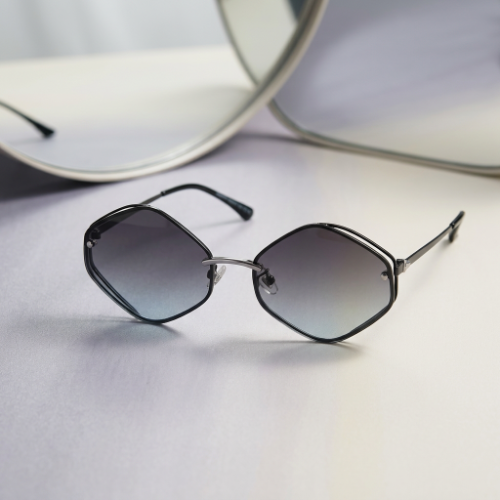
What Frame Shape Pairs Well With What Face Shape
| Face Shape | What It Looks Like | Frames Worth Trying | Frames to Approach Carefully |
|---|---|---|---|
| Round | Soft curves, similar width and length, fuller cheeks | Angular or rectangular shapes, geometric lines | Small, very round frames |
| Oval | Even proportions, slightly narrower chin and forehead | Almost everything, cat-eye and square included | Oversized styles that swallow your features |
| Square | Strong jaw, broad forehead, sharper angles | Rounded or oval lenses, soft cat-eye | Boxy frames that mirror the jawline |
| Heart | Wider forehead, narrower chin, pointed jaw | Bottom-heavy or light rounded frames | Heavy top detailing that widens the forehead further |
| Long | Face noticeably longer than wide | Wider frames, decorative side details | Narrow, small frames that stretch the face further |
If Your Face Is Round
Soft curves and fuller cheeks usually pair nicely with something that adds a little edge. Rectangular frames bring in just enough contrast. A cat-eye shape with a slight upward tilt works too, it lifts the whole look without feeling forced.
If Your Face Is Oval
Lucky you, honestly. Oval faces have fairly even proportions, so there's more room to play. Aviators, cat-eye, square, rounded shapes, most of it works. The one thing worth watching is size, since an oversized frame can throw off that natural balance even on an oval face.
If Your Face Is Square
A defined jaw and broader forehead often look softer next to rounded or oval lenses. Gentle cat-eye frames work in a similar way. Frames with hard, boxy corners usually just repeat the jawline instead of balancing it, so those are worth trying on carefully before committing.
If Your Face Is Heart-Shaped
Wider up top, narrower at the chin, that's the heart shape in a nutshell. Frames with a bit more width at the bottom help even things out. Light, rounded styles do the same job without adding bulk near the forehead.
If Your Face Is Long
When a face runs longer than it is wide, frames with more horizontal presence help bring it back into proportion. Think wider shapes or details running along the sides, like temple accents. Small or narrow frames can end up stretching the look even further, so those are usually not the first choice here.
Fit, Tint, and Material: The Details That Actually Decide If You'll Wear Them
Face shape gets you in the right direction, but a handful of practical details decide whether a pair ends up in your everyday rotation or sitting in a drawer somewhere.
Getting the Width and Bridge Right
A frame that's too wide slides down your nose within an hour. One that's too narrow digs into your temples by lunchtime. Worth checking before you buy:
- Does the frame extend past the widest point of your face.
- Does the bridge sit without pinching.
- Do the temples rest gently, not squeeze.
Picking a Tint Based on How You'll Actually Use Them
This part's often overlooked. Darker tints suit bright outdoor days. Lighter or gradient tints work better for driving or everyday wear, where you still need some visibility. Match the tint to your actual routine, not just what looks good on the shelf.
A Word on Materials
- Acetate frames lean classic, with plenty of color variety.
- Metal frames stay lightweight and a bit more delicate looking.
- Combination frames mix the two for a different kind of balance.
Weight matters more than people expect once you've had a frame on your face for six hours straight.
Color and Skin Tone
Face shape decides structure, skin tone usually decides color. Warmer skin tones often lean toward tortoiseshell, amber, or brown. Cooler skin tones tend to pair well with black, grey, or silver. At the end of the day, trust what looks right when you check the mirror yourself.
A Short Checklist Before You Buy
- Figure out your general face shape using the mirror or photo method.
- Look for a frame that contrasts your shape rather than copying it.
- Check the fit at the bridge, temples, and overall width.
- Think about how you'll use them, daily wear, driving, outdoor activities, and choose tint accordingly.
- Factor in skin tone alongside personal taste when picking color.
- Try them on if you can, and move your head slightly to see if they stay put.
A Few Common Questions
What's the fastest way to figure out my face shape?
Stand in front of a mirror, pull your hair back, and compare the width of your forehead, cheekbones, and jaw. That comparison alone usually points toward one of the common categories.
Is there one frame shape that works for everyone?
Not really, though oval faces tend to have the most flexibility since their proportions are already fairly even. Other shapes usually do better with frames chosen to balance a specific feature.
Does color matter as much as shape?
They work on different levels. Shape affects proportion and balance, while color ties more closely to skin tone and personal style. Both are worth thinking about together.
How can I tell if sunglasses actually fit well?
They shouldn't slide down your nose, pinch at the bridge, or squeeze at the temples. If they stay put when you move your head, that's usually a good sign.
Where This Leaves You
Finding the right sunglasses for your face shape really comes down to understanding your own proportions and picking frames that work with them, not against them. There's no single formula that fits everyone, and personal taste always plays a role alongside the structural stuff.
Try a few shapes before settling. Pay attention to how a frame feels on your face, not just how it looks in a quick glance. Comfort ends up mattering just as much as design once you've worn something for a full afternoon. Keep shape, fit, and everyday practicality in mind, and you'll likely land on a pair that actually feels like yours.

Customized For Your Business
Combining fine craftsmanship with automation technology, we create glasses that are competitive in the market.
Quick Links
Information
Contact Us
-
 No. 7-1, Dengtou Industrial Zone, Duqiao Town, Linhai City, Taizhou City, Zhejiang Province
-
 +86-13666884088
-
 +86-13666884088
-
 +86-573-85505155
-
 [email protected]
Copyright © Zhejiang Zhansheng Glasses Co., Ltd.Rights Reserved.
OEM Eyeglass & Glasses Manufacturer
